
Makeup Content Ideas for 2026: Instagram Formats and Hooks to Test
We analyzed 3,000+ makeup-related Instagram posts and organized the strongest patterns into formats, hooks, and proof angles beauty creators can test.
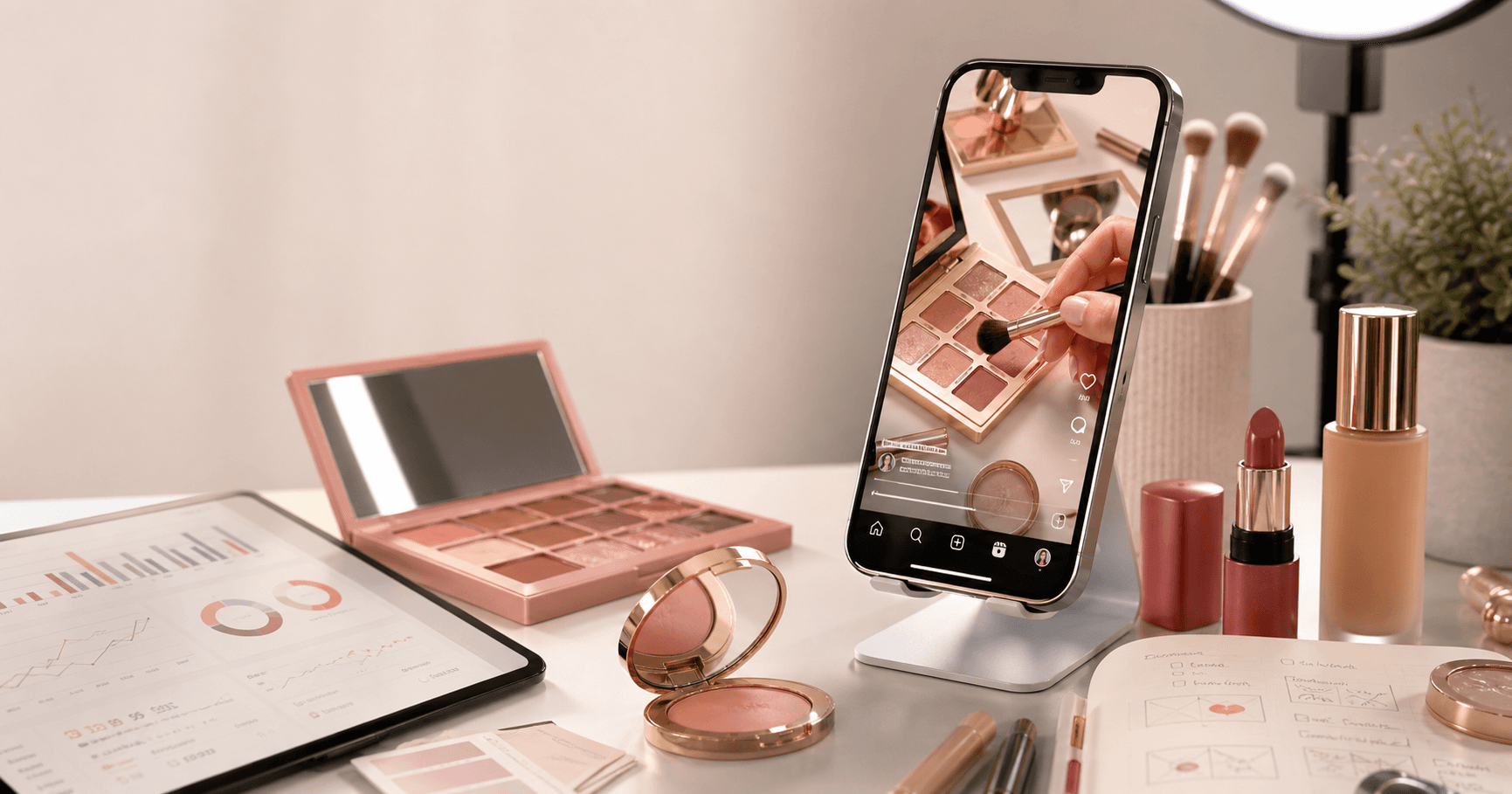
Most makeup creators do not need another random list of product ideas.
They need better framing: a way to turn a product, look, tutorial, or client result into a post viewers can understand and trust quickly.
A lipstick, foundation, blush, or bridal look rarely spreads because the product exists. It spreads when the post gives viewers proof, identity, emotion, or a reason to trust the creator.
ViralVector analyzed 3,000+ makeup-related Instagram posts, including Reels, carousel posts, beauty educators, bridal MUAs, and product-focused accounts. We compared posts that reached strong engagement benchmarks with posts that also beat each creator's usual performance for the same format.
The pattern was clear: stronger beauty posts felt less like product listings and more like creator-led proof.
This guide organizes those patterns into makeup content formats, hooks, and angles to test in 2026. Use it as a playbook for deciding how to frame a post, not just what product to feature. If you also need a baseline for the broader category, compare your posts against the fashion and beauty engagement calculator.
Key Takeaways:
- Product-first posts often underperform when they read like catalogs
- Stronger makeup posts usually show proof, identity, a specific fix, or a visible outcome
- Makeup Reels work best when the creator's face, product result, or story is clear in the first moment
- Beauty creators should turn products into repeatable formats, not one-off product announcements
- Makeup artists should lead with client outcomes before asking for bookings
Makeup Content Format Matrix
Start with the job your post needs to do. Then choose the format and hook that make that job visible.
| Content format | Best for | Example hook | What to test |
|---|---|---|---|
| Wear test | Trust, product proof, saves | "8 hours later on oily skin" | Finished face first vs close-up texture first |
| Shade match | Saves, comments, product decisions | "This shade changed in daylight" | Studio light vs daylight, undertone callout, swatch order |
| Before and after | Bookings, transformations, portfolio proof | "Soft glam that still photographs" | Final result first vs client brief first |
| Product comparison | Shares, buying decisions, dupe culture | "High-end vs drugstore on textured skin" | Split-screen Reel vs carousel breakdown |
| Specific fix | Saves, education, expert trust | "The blush placement mistake I stopped making" | Problem-first hook vs result-first hook |
| Client outcome | Makeup artists, bridal, event work | "Natural, camera-ready skin for a bride who hates heavy base" | Client goal overlay vs behind-the-scenes notes |
| Repeatable series | Returning viewers, content consistency | "Foundation Friday: flash test edition" | Named series vs one-off post |
The rest of this guide breaks down the patterns behind the matrix.
Quick List: 25 Makeup Angles to Test in 2026
If you need makeup content ideas immediately, start here. Each angle can become a Reel, carousel, Story series, or short-form post.
- One-product wear test after 8 hours
- Foundation shade match in daylight vs bathroom light
- Same lip combo on three skin tones
- Bride before and after with the client brief on screen
- Fixing cakey concealer in 20 seconds
- Blush placement for different face shapes
- Products I would actually repurchase
- Makeup mistake I stopped making in 2026
- Drugstore vs high-end foundation test
- Soft glam for someone who hates heavy makeup
- SPF under makeup wear test
- Flash photo foundation test
- Mature skin concealer comparison
- Lipstick transfer test
- GRWM using only products you already own
- Client reaction reveal
- Bridal trial notes
- One palette, three looks
- Hooded eye liner fix
- Worth it or skip? product review
- Full face under $50
- Makeup that survives a summer event
- What I used vs what it looked like
- Before and after with natural lighting
- Weekly series: Foundation Friday or Fix It in 30 Seconds
This list is useful, but the real advantage comes from understanding why these angles work. The strongest makeup content does one of five jobs: prove, fix, help choose, show an outcome, or make the look personal.
Product Post vs. Proof Post
Most weak beauty posts are not bad because the product is bad. They are weak because the viewer has no reason to care yet.
| Product-first post | Proof-first post |
|---|---|
| New foundation review | I wore this foundation for 9 hours on oily skin |
| Trying a red lip | Three red lips that change the whole mood of the face |
| Bridal glam look | Soft glam that still looks like the bride in flash photos |
| My favorite blushes | The blush shades I use when a client says they want to look awake, not done |
| New lip combo | A lip combo that makes minimal makeup look intentional |
The difference is not length. It is the promise.
A product-first post says: here is a thing.
A proof-first post says: here is what this thing does for a real person in a real situation.
1. Format: Turn the Product Into a Visual Claim
Best for: lipstick, blush, foundation, mascara, complexion products, product reviews, and UGC-style beauty content.
A product post gets stronger when it answers a question the viewer already has:
- Will this shade work on my skin tone?
- Does this foundation separate?
- Is this lip gloss sticky?
- Does this blush show up outside studio lighting?
- Is this product worth buying, or is it just trending?
Pattern: Product as a decision hook
One high-performing post in our sample used a Barbie pink lipstick hook tied to cultural attention and a simple question: would you wear this shade?
Post: Barbie pink lipstick example
Why this pattern works:
- The product has a reason to matter beyond the shade name
- The caption creates curiosity around a specific color
- The viewer can immediately form an opinion
- The post invites a decision, not just admiration
Creator takeaway:
If you are posting lipstick, gloss, blush, or foundation, do not just name the product. Turn it into a visual claim.
Try hooks like:
- I tested the viral pink lipstick on real skin
- This shade looked scary in the tube, but different on the lips
- Would this blush work on olive undertones?
- The gloss that looks expensive without feeling sticky
This is the easiest way to turn makeup product content into a testable angle instead of a product announcement.
2. Format: Make the Face the Proof
Best for: transformations, wear tests, before and after posts, texture, mature skin, oily skin, acne-prone skin, and soft glam tutorials.
For makeup content, the human face is not decoration. It is the evidence.
A product close-up can support the post, but the stronger visual is usually a face showing the result: skin texture, glow, eye shape, lip finish, tone match, or expression.
Pattern: Finished result as the hook
One of the strongest visual examples in our sample led with full glam, event context, and a face-first frame. The makeup was not presented as a product demo. It was part of a memorable moment.
Post: finished glam example
Why this pattern works:
- The viewer understands the vibe immediately
- The makeup result is visible before the caption matters
- The post feels like a person, not a product shelf
- The face gives the look credibility
Creator takeaway:
Do not hide the result behind packaging. Lead with the face, then explain the product.
Better structure:
- Show the finished look first
- Add the hook
- Explain the technique or product
- Give the viewer one reason to save, comment, or try it
Proof does not have to mean a dramatic transformation. It can be daylight, close-up texture, flashback, wear time, or a one-eye comparison.
3. Format: Use Makeup as Identity, Not Just Instruction
Best for: beauty creators with a personal brand, Gen Z beauty content, lifestyle creators, editorial makeup, GRWM posts, and humor-led Reels.
One of the strongest patterns in the sample was that personal, lifestyle, humor, and story-led posts appeared far more often in the high-performing group than in the weak group.
That does not mean every makeup creator should become a lifestyle creator. It means makeup often performs better when it belongs to a person, a mood, or a scene.
Pattern: Personal story plus beauty look
Post: Valentine's Day beauty humor example
Why this pattern works:
- The visual is creator-first, not product-first
- The text overlay creates immediate relatability
- The makeup supports the character and mood
- The post is easy to react to even if the viewer is not shopping
Creator takeaway:
A beauty post can start with a feeling.
Angles to test:
- Me pretending I did not spend 45 minutes on this no-makeup makeup
- The look I wear when I need confidence before a date
- Getting ready for an event I almost canceled
- Makeup for when you are single, booked, and unbothered
- Office makeup that still feels like you
- Bride makeup for someone who never wears foundation
People often engage with identity faster than product specs. Let the makeup be part of the story.
4. Format: Teach One Specific Fix
Best for: educational creators, makeup artists, product reviewers, mature skin creators, and creators who want more saves.
Tutorials are not automatically strong. Generic tutorials are everywhere.
The stronger format is a specific fix for a specific makeup frustration.
Pattern: One mistake, one visible fix
One strong post in the sample focused on a narrow issue: over-powdering the under eye and making the area look older.
Post: under-eye powder mistake example
Why this pattern works:
- It names a concrete problem
- It promises a visible improvement
- It feels expert-led without being complicated
- It gives the viewer a reason to save the post
Creator takeaway:
Do not post "my base routine." Post the problem inside the routine.
Tutorial angles to test:
- This is why your concealer looks dry
- Stop setting your under eye like this
- If your foundation separates by noon, check this step
- The blush placement mistake that changes your whole face
- How to stop lipstick from bleeding
- How to make liner work on hooded eyes
- Why your bronzer looks patchy
- How to stop SPF from pilling under foundation
Specific problems create stronger content than broad routines.
5. Format: Show Shade Range as Real-World Proof
Best for: complexion products, lip products, blush, contour, bridal kits, and inclusive beauty content.
Shade range content works best when it is not just a product display. It needs a human reason.
Pattern: Shade range as decision support
One makeup-related Reel in our sample led with a specific promise: 12 shades for Indian skin tones.
Post: shade range example
Why this pattern works:
- The hook is immediately specific
- The value is clear before the viewer watches
- It turns a product range into representation and decision support
- The viewer knows who the post is for
Creator takeaway:
Shade content should answer:
- Who is this for?
- What undertone does it suit?
- What does it look like outside studio lighting?
- Does it flash back?
- Which shade would you actually choose?
Avoid saying "universal" unless you have tested it broadly. Specificity builds more trust than a broad claim.
6. Format: Lead With the Client Outcome
Best for: bridal MUAs, event makeup artists, editorial artists, salon owners, and freelance makeup artists.
If you are a makeup artist, your content should not start with availability. It should start with evidence.
Pattern: Client outcome proof
Post: bridal glam example
Why this pattern works:
- The outcome is clear immediately
- The styling, jewelry, outfit, and makeup support the transformation
- The post sells the artist without sounding like a sales pitch
- The viewer can imagine booking a similar result
Creator takeaway:
Instead of:
Bridal slots open. DM to book.
Try:
Soft bridal glam for a bride who wanted tradition, glow, and no heavy base.
Client-outcome angles to test:
- Makeup that lasts through an outdoor ceremony
- Mother-of-the-bride glam that photographs softly
- Bridal trial notes: what we changed for the final look
- Client wanted natural, camera-ready skin
- Soft glam for clients who hate heavy foundation
- Before and after with the client brief on screen
- What I changed between the trial and wedding day
The booking CTA comes after the viewer believes in the outcome.
7. Format: Build a Repeatable Makeup Content Series
One-off ideas help for a day. Series help creators build memory.
If someone likes one post, a series gives them a reason to come back.
Series angles to test:
| Series | What to Post |
|---|---|
| Foundation Friday | 8-hour wear tests, flash tests, shade matches |
| Fix It in 30 Seconds | One mistake, one correction, one result |
| One Product, Three Faces | Same product across skin tones, ages, or styles |
| Bridal Trial Notes | What the client asked for and what changed |
| Worth It or Skip | Honest product decision posts |
| Makeup That Survives | Heat, sweat, crying, long events, office days |
| Shade Match Diary | Undertone, lighting, oxidation, flashback |
This is where makeup creator content strategy becomes easier: you are no longer asking "what should I post today?" You are filling formats that viewers can recognize.
Makeup Reels Hooks That Work in 2026
The best makeup Reels usually make the viewer understand the value in the first second. If you want a broader hook framework, start with these Instagram hook formulas and adapt them to makeup proof, shade, texture, or client-outcome angles.
Use these shot formats:
Face-first hook
Show the finished look or visible problem first.
Hooks to test:
- This base looked perfect until I checked it in daylight
- The blush placement that changed my whole face
- I finally found a nude lip that does not wash me out
Product-in-action hook
Show the product touching skin, lips, lashes, or the brush immediately.
Hooks to test:
- Watch what happens when this powder hits textured skin
- I tried the foundation everyone says is filter in a bottle
- This lip gloss looks different after five minutes
Text-overlay hook
Use a relatable sentence over a strong visual.
Hooks to test:
- Me pretending this is a 5-minute face
- Makeup I wear when I need to look alive by 8 a.m.
- When the client says soft glam but sends a full beat reference
Split-screen proof
Compare side by side.
Hooks to test:
- Bathroom light vs daylight
- One eye done, one eye not
- With primer vs without primer
- Drugstore side vs high-end side
The point is not to make every Reel loud. The point is to make the value obvious before the viewer scrolls.
How to Test the Hook Before You Post
The same makeup idea can become three very different posts.
Take a foundation review:
- I wore this foundation for 8 hours on oily skin
- This foundation looked flawless until I checked it in daylight
- The foundation mistake I stopped making in 2026
Same product. Three angles. Three different reasons to watch.
If you are unsure which angle is strongest, test it before you publish. ViralVector's A/B Simulator lets you compare different hooks, captions, and creative directions before you spend hours editing a Reel. For a fuller testing workflow, see how to A/B test Instagram posts without posting twice.
Stop guessing which makeup angle will work. Test the hook before you post.
The Pattern to Avoid: Catalog Content
The weakest makeup posts in our sample often had one thing in common: they read like product listings.
Common weak patterns:
- New launch available now
- Shop the bundle
- Comment link
- Products used
- Glow that speaks before you do
- Hydrated, protected, defined, glowy
These phrases are not always wrong. They are weak when they are the whole idea.
The fix is simple: turn the claim into proof or a decision.
| Weak | Stronger |
|---|---|
| This gives a flawless finish | I wore this foundation for six hours on textured skin. Here is where it separated |
| The perfect nude lip combo | Three nude lip combos on pigmented lips, from barely there to full glam |
| Daily essentials edit | A 5-minute face using only three products, tested before work |
| My favorite blushes | The blush shades I use when a client says they want to look awake |
| New mascara launch | One coat vs two coats on straight lashes |
The problem is not selling. The problem is selling before creating belief.
The 2026 Makeup Content Formula
A strong makeup post should do at least one of these jobs:
-
Prove
Show wear, texture, lighting, shade, transfer, coverage, or transformation. -
Fix
Solve one visible problem. -
Choose
Help the viewer decide between shades, finishes, products, prices, or techniques. -
Show an Outcome
Lead with the finished face, client result, or real-world use case. -
Personalize
Connect the look to identity, mood, event, skin type, lifestyle, or client brief.
The strongest makeup content is not just prettier. It is more useful, more human, and more specific. When your goal is saves, use the same proof-first thinking behind these tactics to get more Instagram saves. When your goal is to benchmark performance, compare your results against Instagram engagement rate benchmarks by niche.
In 2026, do not just post the product.
Show why someone should believe it.
Frequently Asked Questions
What are the best makeup content ideas for 2026?
The best makeup content ideas for 2026 are proof-led formats: wear tests, shade matches, before and after posts, specific makeup fixes, client outcomes, product comparisons, and creator-led stories. The idea should answer a real viewer question, not just announce a product.
What makeup Reels ideas work best on Instagram?
Strong makeup Reels usually show the value immediately: a finished face, a visible problem, a product being applied, a side-by-side comparison, or a text overlay that creates instant relatability. Face-first proof and problem-fix Reels are especially useful for beauty creators.
How do you make viral makeup content?
You make stronger makeup content by turning products into proof. Instead of posting a generic review, show wear time, texture, lighting, shade fit, transfer, or a real client outcome. Viral makeup content is usually specific, visual, and easy to understand before the caption is read.
How can a makeup artist go viral on Instagram?
A makeup artist is more likely to stand out by leading with client outcomes: bridal transformations, trial notes, before and afters, soft glam briefs, camera-ready looks, and event-proof makeup. Do not lead with booking availability. Lead with the result someone would want to book.
What should makeup artists post besides before-and-after photos?
Makeup artists can post bridal trial notes, client briefs, product choices for specific skin types, flash photo tests, sanitation routines, kit breakdowns, mistake fixes, client reaction clips, and short explanations of how they adapted a look to the client's face, outfit, and event.
What makes beauty content feel authentic instead of like an ad?
Beauty content feels authentic when the creator shows real use, real skin, real context, and a specific opinion. Product claims feel more trustworthy when they are supported by wear tests, close-up texture, side-by-side comparisons, or a personal reason the creator would use the product.